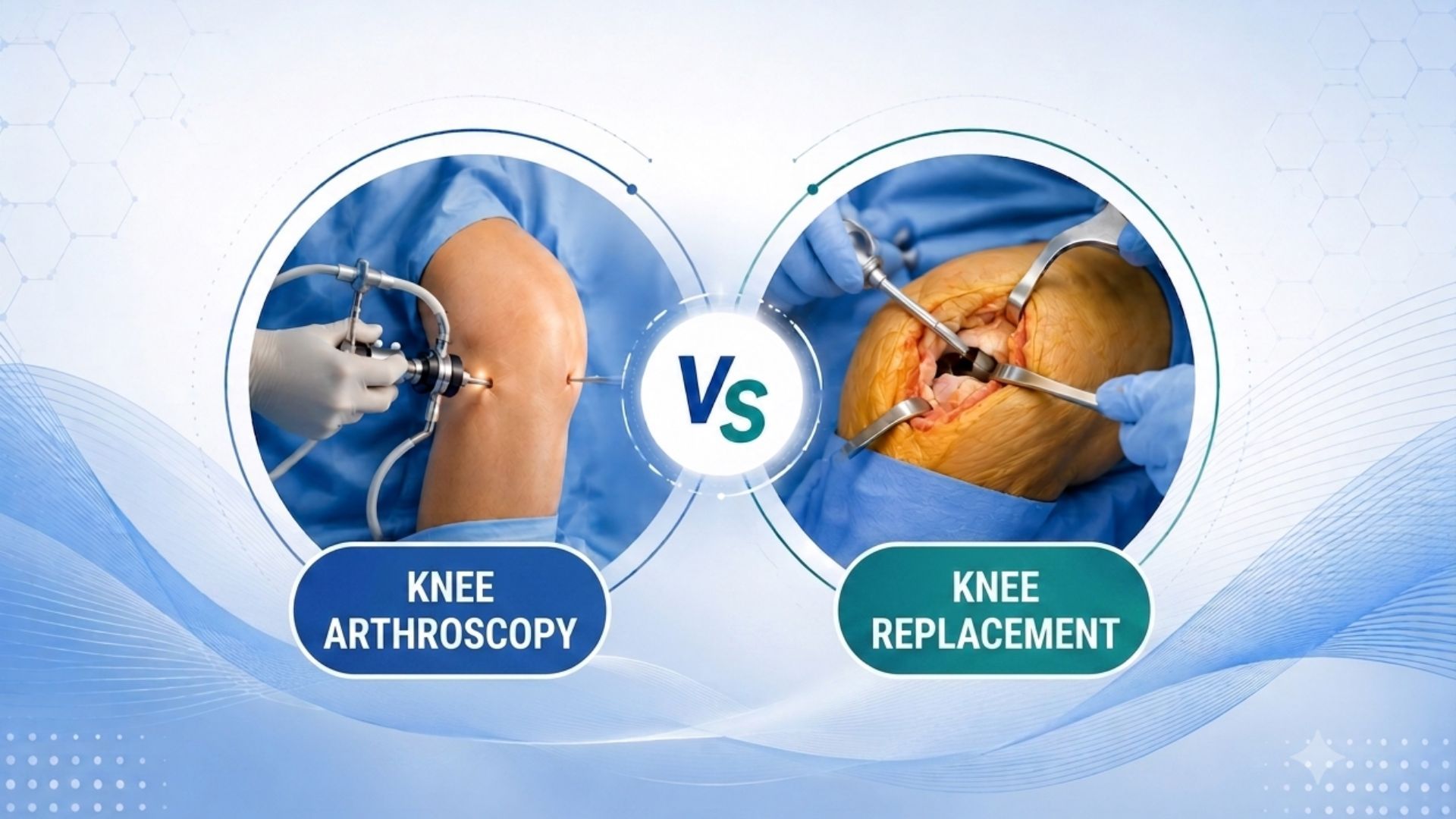
Knee Replacement vs Knee Arthroscopy: What's the Difference?
Introduction
Your knee does more than bend and straightens; it absorbs shock, stabilises your body, and carries you through every step. You feel it climbing stairs, rising from a chair, or simply walking across a room. For millions of people, that persistent pain eventually leads to a conversation with an orthopedic surgeon and often to a question they are not quite prepared for: 'Which surgery is right for me?'
Two procedures come up most frequently in that conversation: knee arthroscopy and knee replacement. On the surface, they may seem similar; they involve surgery on the knee, aim to relieve pain, and require recovery. But they are different in what they do, how they work, who they are for, and what life looks like afterward. Choosing between them is a clinical decision shaped by age, diagnosis, severity of joint damage, and long-term goals.
Different Types of Knee Procedures
The knee is a joint that involves bones, cartilage, ligaments, and tendons, all of which are susceptible to injury or degeneration. Surgical interventions for the knee broadly fall into two categories:
Minimally invasive procedures – such as arthroscopy, used for targeted repair
Joint replacement procedures – involving partial or total replacement of the knee joint
The choice between these depends on the nature and severity of the knee problem, the patient's age, activity level, and overall health.
What Is Knee Arthroscopy?
Knee arthroscopy allows surgeons to diagnose and treat a wide range of knee conditions without a large incision. During the procedure, an arthroscope is inserted into the knee joint through tiny incisions, or portals.[1]
What Is Knee Replacement Surgery?
In a knee replacement surgery, also called knee arthroplasty, the damaged bone and cartilage in the knee joint are cut out, and a prosthetic implant made of metal and plastic is inserted. Knee replacement is recommended for people with severe pain from arthritis, particularly osteoarthritis.[2]
The types of knee replacement are:
Total Knee Replacement (TKR): The surgeon replaces all three compartments of the knee joint, medial (inner), lateral (outer), and patellofemoral (beneath the kneecap). Also called total knee arthroplasty (TKA), it is the most common type.
Partial Knee Replacement (PKR): Only one or two compartments of the knee are replaced. This may be suitable for selected patients with damage limited to one or two compartments of the knee.
Key Differences between Knee Replacement and Knee Arthroscopy
The table below summarises the key differences between the two procedures:
Feature | Knee Arthroscopy | Knee Replacement |
Procedure Type | Minimally invasive, keyhole surgery | Major open or minimally invasive surgery |
Purpose | Diagnose and repair specific knee problems | Replace damaged joint surfaces entirely |
Incision Size | 2–3 small portals (~5 mm each) | Larger incision over the knee |
Anaesthesia | Local, regional, or general | General or spinal (regional) |
Hospital Stay | Usually outpatient (same day) | An overnight or 1–2 day stay is common |
Recovery Time | Return to activity in 6–8 weeks (minor procedures) | Full recovery up to 12 months |
Implants Used | None (natural joint preserved) | Metal and plastic prosthetic implants |
Best Suited For | Younger patients; specific, localised injuries | Older patients; severe, widespread arthritis |
Longevity of Result | Depends on the underlying condition | Implants can last 15–20+ years |
When Doctors Recommend Knee Arthroscopy
Doctors may recommend knee arthroscopy in cases where minimally invasive treatment is appropriate, such as:
A meniscus tear causes persistent pain and locking of the knee.
An ACL injury prevents stable knee function, especially in active individuals.
Loose bone or cartilage fragments are present within the joint.
Inflamed synovial tissue (synovitis) causes ongoing discomfort.
Knee pain persists despite conservative treatment, and imaging confirms a correctable structural problem.
When Knee Replacement May Be the Better Option?
Knee replacement becomes the recommended course of action when:
Arthritis has caused extensive, irreversible cartilage loss across the joint.
Knee pain significantly limits walking, climbing stairs, or getting up from a chair.
Non-surgical treatments, including physiotherapy, injections, and medications, have failed.
X-rays confirm severe joint space narrowing.
The quality of life is significantly compromised despite other interventions.
The right artificial joint and surgical technique depend on several factors, including age, weight, activity level, and overall health. [4]
What to Expect After Knee Arthroscopy
Post-operative care following arthroscopy is focused on reducing swelling, managing pain, and restoring motion. Patients can typically expect:
Discharge from the facility within 1–2 hours of surgery.
Use of crutches for a short period if required.
Ice application and leg elevation to manage swelling.
A formal physiotherapy program to restore the range of motion and strength.
The ability to drive within 1–3 weeks for minor procedures (as directed by the surgeon).
Patients who have not undergone ligament reconstruction or meniscal repair can typically return to most physical activities within 6 to 8 weeks.[1]
Recovery Timeline after Knee Replacement
Recovery after knee replacement is a more gradual process. It usually takes around a year to fully recover, though most patients can resume usual activities within six weeks.[3] A typical recovery timeline includes:
Days 1–3: Begin gentle exercises and walking with support. Focus on reducing swelling with ice and elevation.
Weeks 1–6: Work with a physiotherapist to improve knee bending and strength. Most patients can walk without assistance by week 6.
Months 3–6: Gradual return to low-impact activities such as walking, swimming, and cycling.
Up to 12 months: Full recovery with reduced pain and improved mobility and quality of life.
Knee replacements can last at least 15 to 20 years. Hence, a long-term solution for end-stage joint disease.[2]
Conclusion
Knee arthroscopy and knee replacement serve very different purposes and are suited to different patient profiles. Both procedures have high success rates when performed on appropriately selected patients. The best outcomes are achieved through a thorough clinical evaluation, accurate imaging, and a personalised treatment plan developed in consultation with a qualified orthopedic specialist. If you are experiencing persistent knee pain, speaking with an orthopedic surgeon is the most reliable way to determine which procedure, if any, is right for you.