

























World Arthritis Day 2026: Raising Awareness About RMDs
Introduction
Do you recall waking up in the morning with sore knees and thinking nothing of it, blaming “aging”? Do you see your parents struggling while opening a jar and think it’s because of a bad day? Most of us do not take joint pain seriously, but persistent joint pain or stiffness may sometimes be an early sign of arthritis or another rheumatic and musculoskeletal disease (RMD).
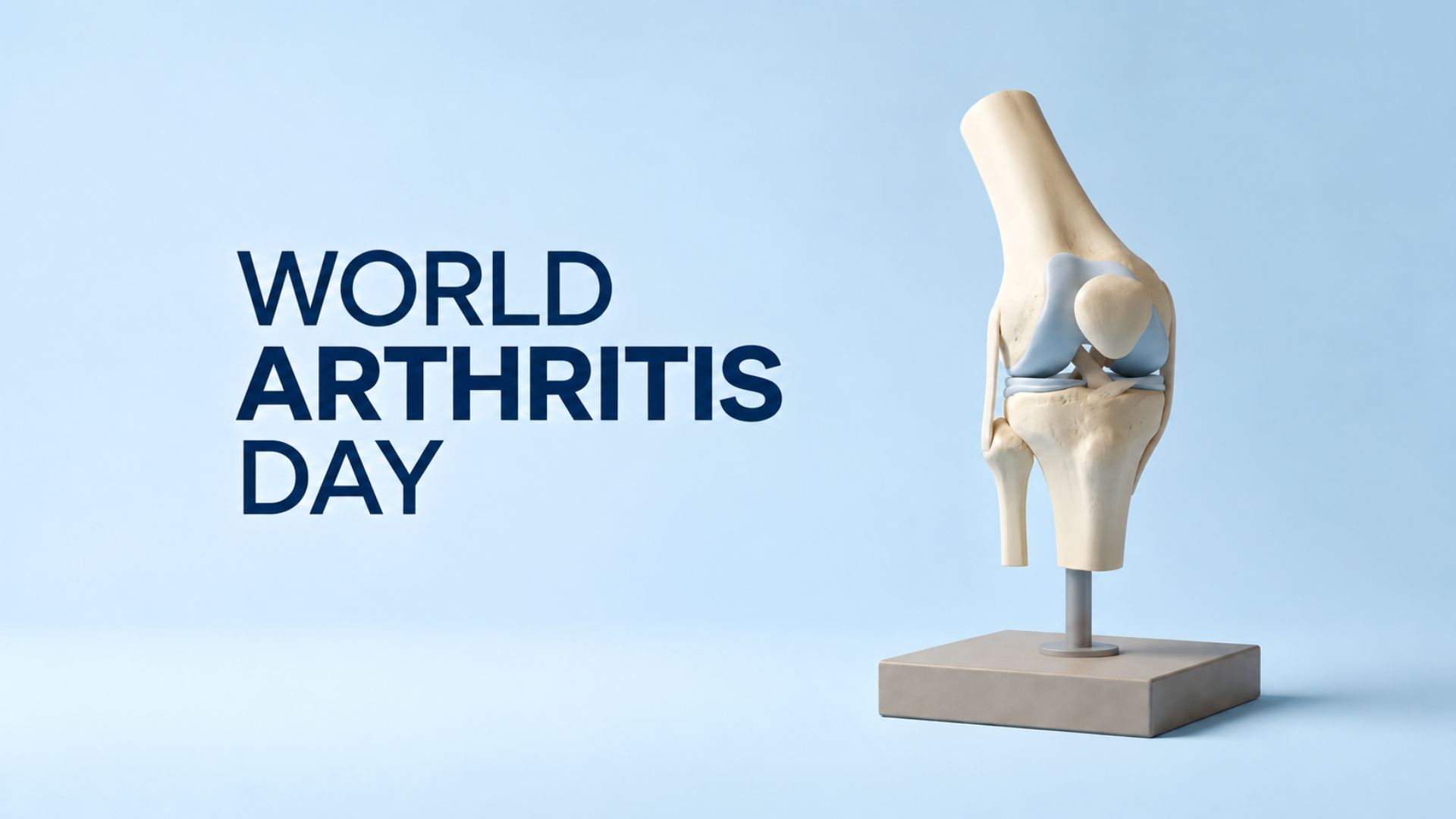
World Arthritis Day, observed every year on 12 October, exists to change that habit. This blog walks you through what the day means, the early signs to watch for, and how to actually protect your joints, in plain, simple language.
What Is World Arthritis Day, and Why It Matters to You
World Arthritis Day was established by Arthritis and Rheumatism International (ARI) in 1996 and is now supported by EULAR, the European Alliance of Associations for Rheumatology and marked in countries across the world, including India.
The goal is simple: get people talking about joint health before small aches turn into bigger problems. RMDs include:
Osteoarthritis, a condition involving progressive changes in cartilage, bone and other joint tissues.
Rheumatoid arthritis, an autoimmune condition.
Gout, sudden, intense joint pain caused by uric acid crystal build-up, often in the big toe.
Psoriatic arthritis, joint inflammation that can accompany the skin condition psoriasis.
Ankylosing spondylitis, inflammation that mainly affects the spine and lower back.
Lupus and dozens of other inflammatory and autoimmune joint conditions.
How You Can Get Involved in World Arthritis Day 2026
You don't need to be a doctor to make a difference this World Arthritis Day. A few simple actions go a long way:
Talk about it. Ask an older family member how their joints are doing, honestly, not just in passing.
Get a joint check-up if you've had unexplained stiffness or swelling for more than a few weeks.
Share what you learn here with your family WhatsApp group or workplace wellness channel.
Support a local walk, screening camp, or awareness drive run by hospitals or rheumatology associations.
Encourage movement at home; a short walk together counts as awareness in action, not just words.
Early Signs of Arthritis and RMDs You Shouldn't Ignore
Not all joint pain is the same, and knowing the pattern helps you know when to act. In a study of rheumatoid arthritis patients in Central India, early morning stiffness was reported by 84.3% of patients, and joint pain by 97.5%.[1] Watch for:
Stiffness after waking up
Swelling, warmth, or redness around a joint, especially in both hands or feet at once
Pain that doesn't fully go away with rest
Unexplained fatigue alongside joint discomfort
Weaker grip strength or trouble with simple tasks like opening jars or buttoning a shirt
If any of these sound familiar and have lasted more than a couple of weeks, it's worth getting checked rather than waiting it out.
Healthy Joints vs Osteoarthritis vs Rheumatoid Arthritis: What's the Difference?
"Arthritis" is often used as a blanket term, but osteoarthritis (OA) and rheumatoid arthritis (RA) are distinct conditions with different causes. Here's a simple side-by-side comparison:
Feature | Healthy Joint | Osteoarthritis | Rheumatoid Arthritis |
What's happening | Smooth cartilage cushions the bone; no pain or swelling | Cartilage wears down over time; bone rubs on bone | The immune system attacks joint lining by mistake |
Who does it usually affect | Anyone, at any age | Older adults, or joints under repeated strain | Can start at any age, most often 30 to 50 |
Pattern of pain | None | Worsens with activity, eases with rest | Worse in the morning, eases as you move |
Swelling and warmth | None | Mild, if any | Common, often in both hands or feet at once |
Typical stiffness | None | Brief, under 30 minutes | Often lasts over 30 minutes to an hour |
Another difference worth noting: Rheumatoid arthritis is more common in women than in men. According to the US National Institute of Arthritis and Musculoskeletal and Skin Diseases, approximately two to three times as many women as men have RA.[2] So if the women in your family seem to complain about joint pain more often, it's not just in their heads.
Why Early Diagnosis Protects More Than Just Your Joints
Untreated inflammatory arthritis doesn't just stay in the joints. Left unmanaged, conditions like RA can quietly raise the risk of heart problems, too. Research links RA to nearly double the cardiovascular risk of the general population.
Early assessment can help establish the diagnosis and allow appropriate treatment to begin before significant joint damage develops.
Managing RMDs in Everyday Life: What Actually Helps
Lifestyle and Movement Habits
Managing arthritis isn't about doing one big thing right. It's about a few small habits, done consistently:
Move a little, often- Low-impact activity like walking, swimming, or yoga keeps joints from stiffening up, even a 20-minute daily walk helps.
Watch your weight- Every extra kilogram adds real load on weight-bearing joints like knees and hips.
Eat joint-friendly- Include anti-inflammatory foods like leafy greens, fatty fish, nuts, and turmeric in your everyday meals.
Protect your joints at work- Take breaks from repetitive tasks like typing, kneading dough, or squatting for long stretches.
Rheumatologist or General Physician: Who Should You See?
For everyday joint aches, a general physician is a perfectly good first stop; they can rule out simple causes and refer you onward if needed. But some signs point straight to a rheumatologist, a doctor who specialises in joint and autoimmune conditions:
Swelling or stiffness that's symmetrical
Morning stiffness lasting over an hour
A family history of rheumatoid arthritis, lupus, or similar autoimmune conditions
Joint pain along with unexplained fatigue, low-grade fever, or skin rashes
If you're checking off more than one of these, ask your general physician for a direct referral to a rheumatologist rather than waiting through multiple rounds of general treatment first.
Conclusion
Joint pain is easy to dismiss, until it isn't. This World Arthritis Day, the simplest thing you can do is stop treating stiffness and swelling as background noise. Notice the pattern, ask the questions, and get checked early if something feels off, for your own joints or a parent's.