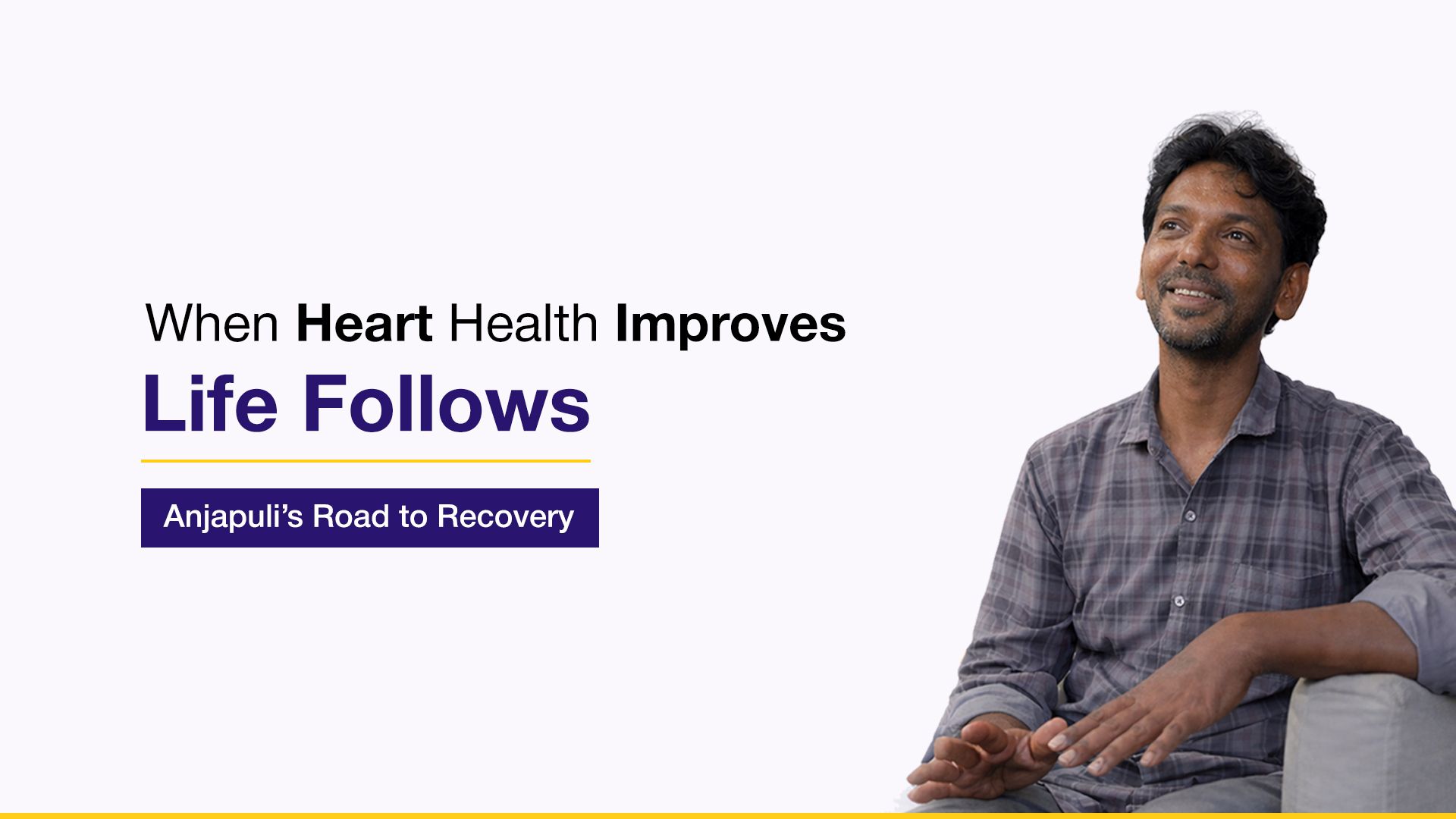
Anjapuli’s Journey toward Better Heart Health
Introduction
Some patient journeys stay with you — not because they are extraordinary, but because they reflect the very human side of medicine.
Anjapuli Chinnakalay never imagined that fatigue would become the defining challenge of his days. What began as mild breathlessness slowly crept into every corner of his life. Climbing stairs left him winded. A simple walk felt exhausting. Long hours at work became unbearable. He dismissed it at first — stress, perhaps, or age catching up. But his heart was telling a different story.
Diagnosis: Severe Mitral Regurgitation
When he finally sought medical care, he came under the expertise of a renowned Interventional Cardiologist. The first step was clarity — and clarity came through a 2D echocardiogram.
The images revealed what his body had been struggling to compensate for: severe mitral regurgitation. With every heartbeat, blood was leaking backwards through the mitral valve rather than flowing forward efficiently. His heart’s pumping function — the ejection fraction — was significantly reduced. The heart had enlarged from the strain. The backward leak was also increasing pressure in his lungs, explaining the breathlessness that had slowly taken over his life.
When Anjapuli heard the words “heart failure,” fear set in.
“I worried about my family. My future. Whether I would ever feel normal again,” he later shared.
When Medication Was Not Enough
The doctor explained that while medications are the foundation of heart failure treatment, in Anjapuli’s case, medical management alone was not enough. The severe leakage was driving his worsening condition. In fact, despite optimised therapy, the heart continued to struggle. Simply increasing medications was no longer helping — it was becoming counterproductive.
A Minimally Invasive Approach
There was, however, another path.
He recommended a minimally invasive mitral valve clipping procedure—a catheter-based intervention designed to reduce leakage by approximating the mitral valve leaflets. By correcting the backward flow, the heart could finally pump forward more effectively, and lung pressures would reduce.
During the procedure, guided by real-time 2D echo imaging, the clip was precisely positioned across the leaking valve. Once it was deployed, the regurgitation was significantly reduced following the procedure. Soon after the clip placement, the team observed a rise in his blood pressure by nearly 20 mmHg — an indication that forward blood flow from the heart had improved.
Recovery and Improvement
With the leak corrected, everything changed.
Now, his overall treatment plan could be optimised more effectively, something that had not been possible earlier, as the ongoing valve leakage continued to strain the heart. His recovery was steady and progressive.
Over weeks, breathlessness began to ease. Energy levels improved. Follow-up 2D echocardiography showed encouraging changes:
- The severity of mitral regurgitation had reduced significantly.
- Cardiac dimensions showed signs of improvement.
- The ejection fraction showed modest improvement.
- Overall, these changes were consistent with improved cardiac function.
The pressure on his lungs was reduced, contributing to an improvement in his symptoms. His heart no longer had to overwork to compensate for a failing valve.
A Return to Everyday Life
And slowly, Anjapuli began to feel something he hadn’t felt in months — normal.
“I feel like I have my life back,” he says now, with quiet gratitude.
His journey is not just about a procedure. It is about timing, precision, and partnership. It is about recognising when technology can intervene at the right moment to alter the course of disease. It is about understanding that innovation in cardiology is not measured only in millimetres of clip placement or numbers on an echo report — but in restored confidence, regained strength, and reclaimed lives.
Because sometimes, the greatest success in medicine is simply helping someone feel like themselves again.
A patient simply saying, “I feel like myself again.”
Disclaimer: The information contained in this blog represents the views and opinions of the doctor and patient and does not necessarily represent the views or opinions of Meril. This content has been made available for informational and educational purposes only is not intended to be a substitute for professional medical advice, diagnosis, or treatment. Always seek the advice of your physician or other qualified health provider with any questions you may have regarding a medical condition.
Watch the Patient Story
YouTube Video Link: The Power of Innovation in Heart Care | Anjapuli’s Success Story with TEER