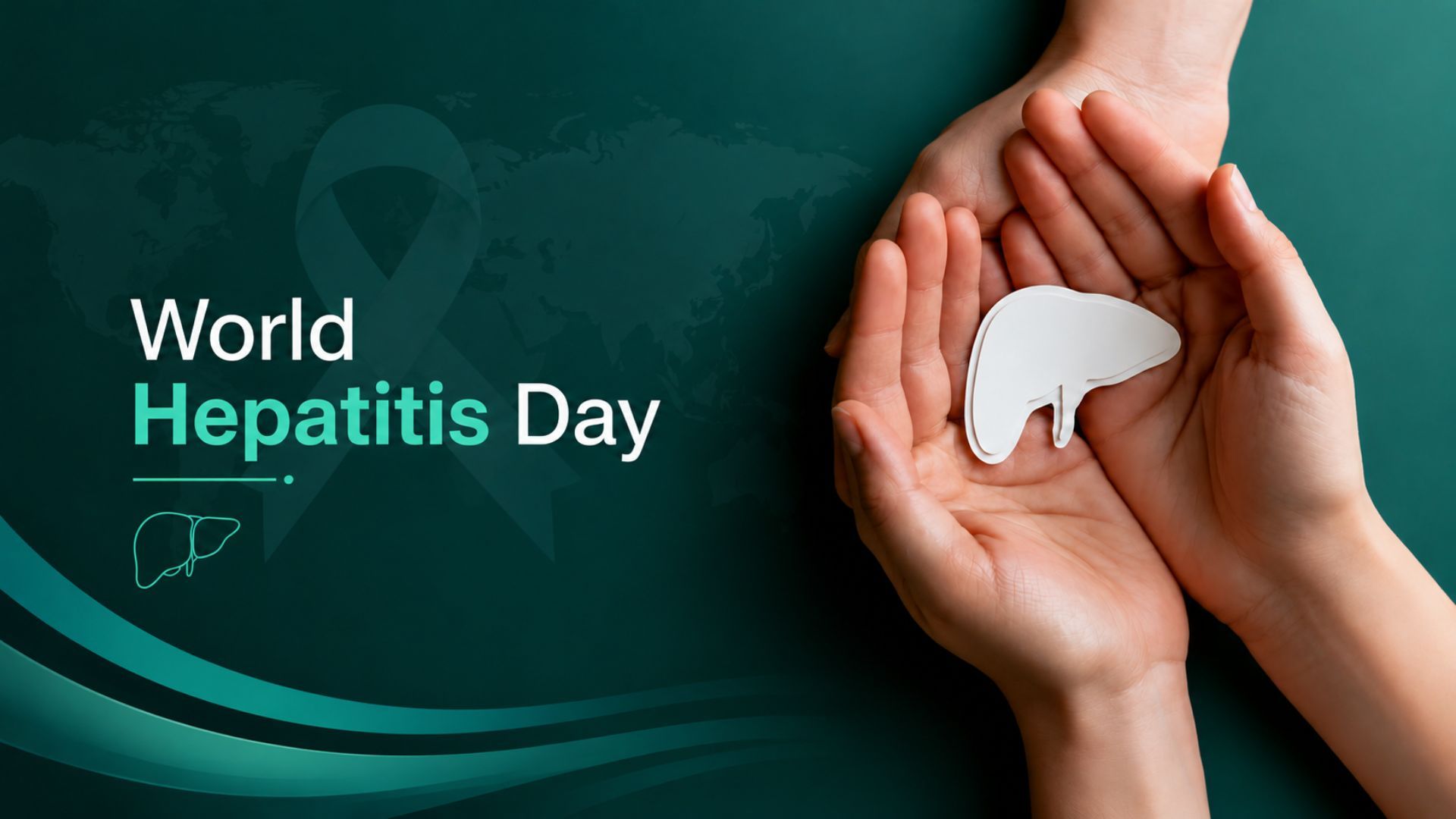
World Hepatitis Day 2026: Why Accelerated Action against Hepatitis Matters
Introduction
Every year on the 28th of July, the world confronts a silent crisis that claims over 1.3 million lives, or 3,500 people every single day. Yet Hepatitis barely registers in most people's minds.[1]
Hepatitis is an inflammatory condition of the liver due to viral infection and poses itself as a contender against tuberculosis in terms of a major infectious cause of death. This World Hepatitis Day 2026, the clear message from the global health community is that urgent action is now inevitable. India has one of the highest burdens of Hepatitis worldwide.
What Is World Hepatitis Day?
World Hepatitis Day is observed every year on the 28th of July to raise global awareness of viral hepatitis and to accelerate efforts to eliminate it. The date honours Dr. Baruch Blumberg, who discovered the Hepatitis B virus. The World Health Assembly officially established this day in 2010, making it one of only four disease-specific awareness days recognised by the WHO. For 2026, the focus sharpens on accelerating action.
Key activities on World Hepatitis Day include:
Awareness campaigns by governments and health organisations
Free or subsidised Hepatitis screening drives
Amplified public education through social media and community events
Understanding Hepatitis: Types and How It Spreads
There are five main types of Hepatitis, namely A, B, C, D, and E, each with different modes of spread and health outcomes.
Type | Mode of Spread | Chronic Risk | Vaccine Available? |
Hepatitis A | Contaminated food/water | No | Yes |
Hepatitis B | Blood, sexual contact, mother-to-child | Yes, up to 90% in infants | Yes |
Hepatitis C | Blood-to-blood contact | Yes, around 75–85% cases | No |
Hepatitis D | Only with Hepatitis B co-infection | Yes | Hepatitis B vaccine provides protection |
Hepatitis E | Contaminated water | Rare, except in pregnancy | Limited availability |
Hepatitis B and C viruses are regarded as being the most life-threatening viruses among those that cause viral Hepatitis, as they are able to remain asymptomatic and eventually lead to cirrhosis, liver dysfunction, and liver cancer. In India, viral Hepatitis at present has roughly 40 million cases of chronic Hepatitis B infection and 6 to 12 million cases of Hepatitis C infection.[2] While Hepatitis A and E viruses mostly cause acute infections due to unsanitary conditions.
The Global Burden of Hepatitis
The numbers demand attention. According to the WHO's Global Hepatitis Report 2024, there are approximately 254 million people living with Hepatitis B, while about 50 million people have Hepatitis C globally. Viral Hepatitis claims nearly 1.3 million lives each year and hence ranks as the second-highest infectious cause of death after tuberculosis. [1]
The diagnosis gap is what makes this crisis so preventable yet persistent. According to the WHO review[1]:
Only 13% with chronic Hepatitis B had been diagnosed by the end of 2022
A mere 3% were on antiviral therapy
Only 36% of people living with Hepatitis C had been diagnosed between 2015 and 2022
According to the WHO Global Hepatitis Report 2026, the world is off track to meet 2030 elimination targets. In 2024, 1.1 million people died from Hepatitis B.[6]
Hepatitis in India: Current Scenario
India ranks among the countries hardest hit by this problem. According to the WHO Global Hepatitis Report 2024, India accounted for 11.6% of the total global viral hepatitis burden in 2022, second only to China.[3]
Key figures from India:
29.8 million Indians were living with Hepatitis B in 2022
Over 50 lakh (5 million) Indians are estimated to have Hepatitis C.
India accounts for 58% of global Hepatitis C deaths.
Common risk factors in India include mother-to-child transmission at birth, unsafe medical practices, unscreened blood transfusions, and contaminated water.
Why Accelerated Action Is Needed Now
Prevention and Vaccination: The First Line of Defence
The Hepatitis B vaccine, available since the 1980s, is effective in preventing infection. Vaccination within 24 hours of birth is critical to stopping mother-to-child transmission.[4] India's Universal Immunisation Programme (UIP) includes this vaccine for newborns, but coverage gaps persist in rural areas. India's Universal Immunisation Programme (UIP) includes this vaccine for newborns, but coverage gaps persist in rural areas.
Prevention measures:
Vaccination at birth; delay of the first dose must be avoided.
Sterile needles must be used.
Hygiene and a clean water supply should be practised to avoid Hepatitis A and Hepatitis E.
For Hepatitis C, no vaccine is available; therefore, precaution is the only preventive measure.
Every vaccinated child is a life potentially saved from decades of chronic liver disease.
The Importance of Hepatitis Screening and Early Detection
The most dangerous truth about Hepatitis is that most people with Hepatitis B or C have no symptoms for years. By the time jaundice, fatigue, or abdominal pain appear, serious liver damage may already be done.
Early detection matters because:
Starting the treatment process before liver damage becomes permanent
Prevention and delay of cirrhosis and liver cancer
Prevention of the spread to one's family members or partner
Who should get screened for Hepatitis in India?
Anyone who received a blood transfusion
Healthcare workers with blood exposure
Newborns to mothers infected with Hepatitis B or C
People with undiagnosed liver problems or high levels of liver enzymes
Screening requires only a simple blood test. India's National Viral Hepatitis Control Programme (NVHCP) offers free testing and treatment at district hospitals. If you are at risk, act today.
Conclusion
World Hepatitis Day 2026 is a call to move faster. Vaccines, cures, and detection tools exist. The one thing that seems to be missing is the sense of urgency needed to use these on a larger scale.
India has almost 40 million cases of Hepatitis B, and around six to 12 million people are chronically infected with hepatitis C.[5] Awareness, screening, vaccination, and accessible care must reach every community.